
Louisiana Financial Literacy Statistics
The Louisiana Financial Educators Council (LFEC) deepens statewide understanding of financial wellness by continually gathering fresh data to ensure that this webpage reflects the most accurate, up-to-date information available. These insights flow to policymakers, advocates, researchers, community organizations, and the public, creating a dependable foundation for thoughtful decision-making and meaningful action. By sharing these statistics, LFEC fuels stronger advocacy and more strategic policy development, reaffirming the Council’s commitment to improving financial well-being for people across Louisiana.
Cost of Financial Illiteracy Survey
Louisianians report that lack of financial knowledge carries a high cost, according to the NFEC’s most recent survey. Participants across the state responded to the single question: “During the past year, about how much money do you think you lost because you lacked knowledge about personal finances?” The results are shown below. Since 2017, the NFEC has conducted this annual survey, consistently revealing that the average individual cost of financial illiteracy approaches or exceeds $1,000 per person – with estimated national losses reaching into the hundreds of billions of dollars each year, and losses in the hundreds of millions across Louisiana.
Cost of Financial Illiteracy
$0 – $499
$500 – $999
$1,000 – $2,499
$2,500 – $9,999
$10,000 +
Louisianans’ Financial Vulnerability
Each year the National Education Association (NEA) publishes a report that summarizes totals of K-12 public schools, educators, and student enrollments state-by-state. The most recent report was released in April 2026. During the 2024-2025 school year, the report indicates, Louisiana had 163 operating public schools. Fall enrollment in 2024 was at 676,751 and there were 47,434 teachers serving those students – a student-to-teacher ratio of 14.3 to 1.
In 2025 the Louisiana Legislature revised its education statute by enacting RS §17:270, requiring that students successfully complete a one-unit Financial Literacy course as a condition for high school graduation. Financial literacy concepts also are included in most of the Social Studies standards for grades K-8. The American Public Education Foundation (APEF) suggests that Louisiana could improve its financial education standards by implementing more foundational requirements for students in the elementary grade levels.
If “housing insecurity” is defined broadly—housing insecurity as broader than literal homelessness or being behind on rent, and including measures of housing-cost burden, severe housing problems, instability/eviction risk, and housing adequacy—then about 20%–24% of Louisiana households experience meaningful housing insecurity, with approximately 22% being a reasonable single-number estimate.
This estimate is supported by several indicators, including:
- Louisiana’s relatively high poverty rate and lower comparable income when compared to other states
- Shortage of affordable rental units for the lowest-income households
- Population vulnerability to housing-related financial shocks
- The state’s affordable-housing shortage: Louisiana has a deficit of approximately 104,000 affordable and available units for extremely-low-income renters
Sources used to generate this estimate are listed at the bottom of this page.
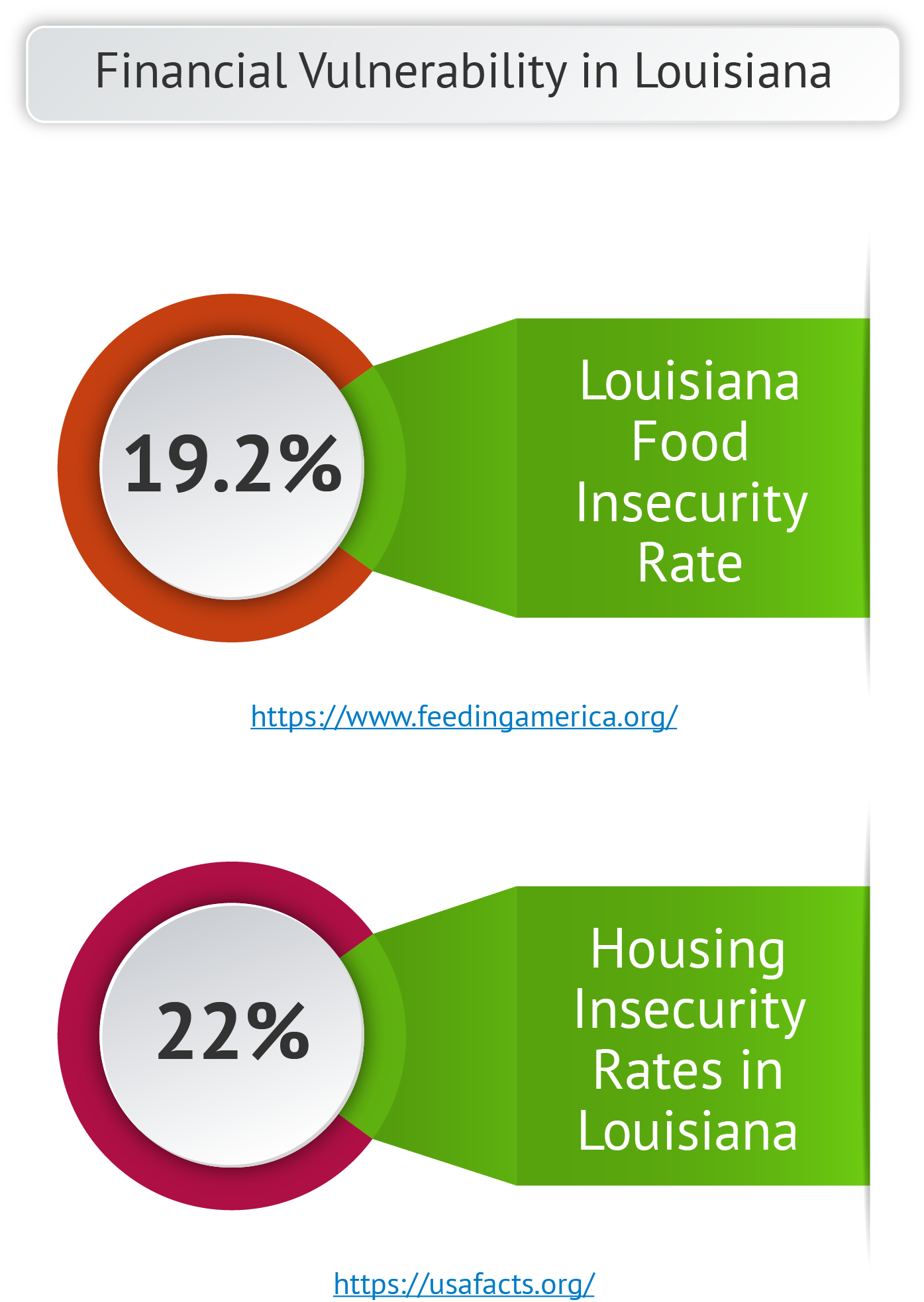
Financial Situations Among Louisianans
Average Total Consumer Debt
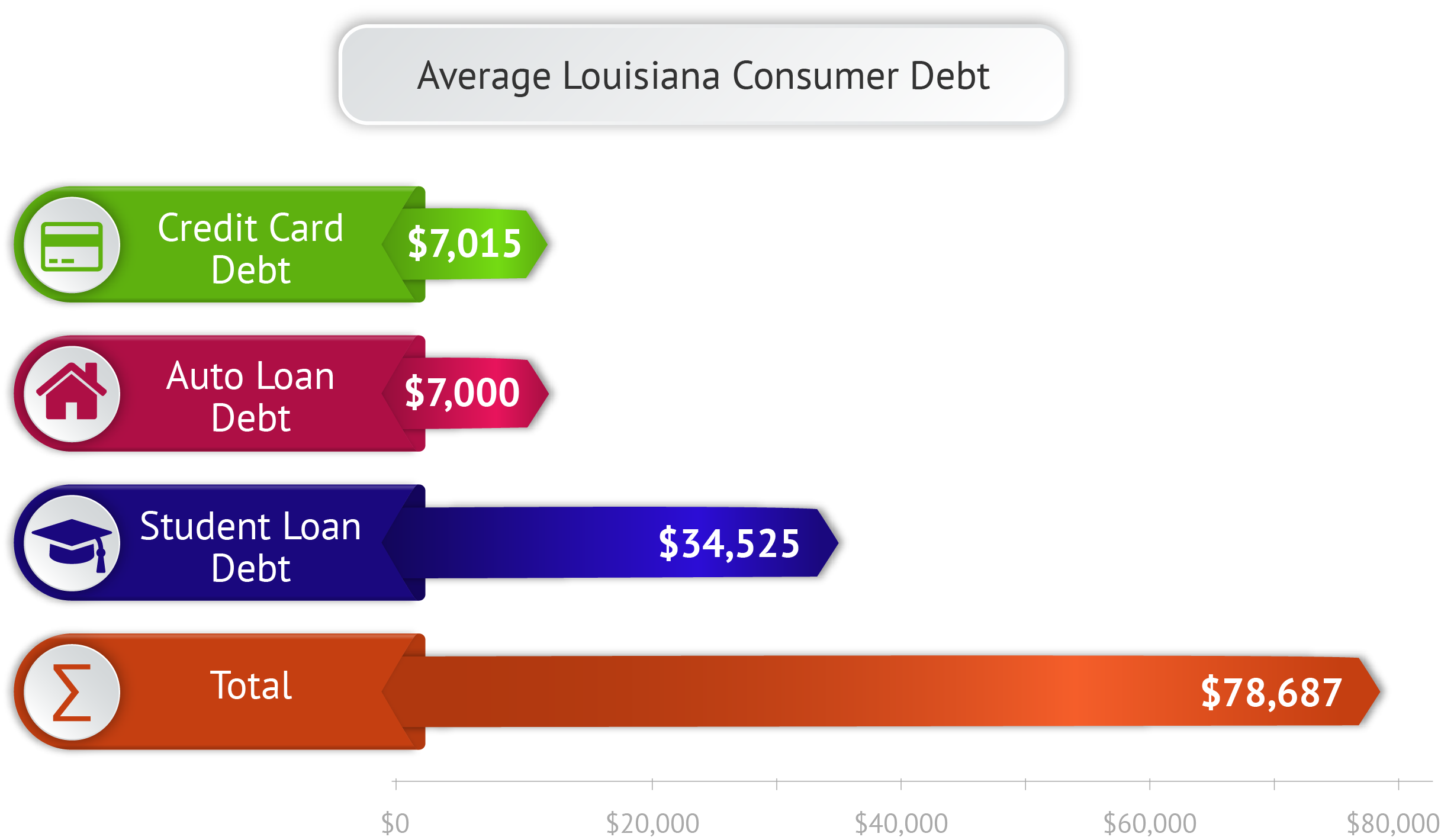
Consumer debt has become an increasingly prevalent problem in the United States, with totals soaring over $18 trillion as of January 2026. Louisiana data collected by Experian are consistent with this trend: the state’s residents held an average of $78,687 in total consumer debt as of September 2025. While that figure sits well below the national average of $104,755, household debt clearly remains a major issue among Louisiana’s citizens.
Debt Totals by Type
We provide a more granular analysis by breaking down the total debt load into more specific categories. First, as the cost of higher education skyrockets across the country, the amount of student debt a college graduate carries has increased in pace. Among Louisianans who owe balances on student loans, the World Population Review places the average at $34,525.
Credit card debt offers further perspective. In the Pelican State as of March 2026, adults held about 3 credit cards each and carried a total average balance of $7,015, according to WalletHub. In addition, data from the World Population Review showed Louisianans obligated for an average of $7,000 in auto loan debt. Since that figure was estimated in 2024, the amount is likely to be higher today.
Financial Literacy Education and Legislation in Louisiana
Each year the National Education Association (NEA) publishes a report that summarizes totals of K-12 public schools, educators, and student enrollments state-by-state. The most recent report was released in April 2026. During the 2024-2025 school year, the report indicates, Louisiana had 163 operating public schools. Fall enrollment in 2024 was at 676,751 and there were 47,434 teachers serving those students – a student-to-teacher ratio of 14.3 to 1.
In 2025 the Louisiana Legislature revised its education statute by enacting RS §17:270, requiring that students successfully complete a one-unit Financial Literacy course as a condition for high school graduation. Financial literacy concepts also are included in most of the Social Studies standards for grades K-8. The American Public Education Foundation (APEF) suggests that Louisiana could improve its financial education standards by implementing more foundational requirements for students in the elementary grade levels.